Our keynotes.

Our keynotes.
The Sense and Nonsense of Generational Thinking
We’ve been hearing it for generations: “Young people these days don’t know what hard work is.”
But did you know people were saying the same thing in the 1950s, in Aristotle’s time, and even in ancient Egypt?
The way we look at other generations often says more about ourselves than about “young people.”
Generational thinking is, therefore, back from the dead — or rather, it never went away.
And although the idea of generations has existed throughout history, it’s more relevant than ever today.
At work, in politics, and within families, values, expectations, and communication styles collide between generations — and we’re becoming increasingly aware of that.
👉 What moves us forward? And what keeps us trapped in assumptions?
In the keynote “Conversations about Generations: The Sense and Nonsense of Generational Thinking,” we’ll take you through:
🔍 The origin of generational thinking
💭 How stereotypes like “Gen Z is lazy” or “Boomers don’t understand technology” arise
🧠 And most importantly: the power and the limitation of thinking in generations
Generational thinking works … as long as it helps us to understand differences and strengthen collaboration. But it becomes dangerous when it narrows our thinking — when whole groups are painted with the same brush and reduced to caricatures.
The real insight?
We don’t have a generation problem. We only think we do.
By looking beyond age — towards life stage, zeitgeist, and context — we create space for understanding, connection, and better collaboration.
Exactly what organisations need in an era where generations don’t automatically understand one another, but absolutely depend on each other to move forward.
This keynote isn’t meant to box generations in, but to loosen up fixed beliefs.
Because innovation always begins with letting go of old assumptions.

The Path to Future Revenue Potential
Improving and innovating are fundamentally different actions. When you improve, you build on the knowledge you already possess to optimise existing processes. Improvements are tangible, plannable, and directly applicable. Innovating, on the other hand, means taking an entirely new direction; through exploration and innovating you discover new possibilities. That is why innovation is intangible, uncertain, and harder to grasp immediately.
Improving is important for an organisation to continue performing well in the current era. Innovating is essential for anticipating the moment a new era arrives. The environment in which your organisation operates can suddenly shift — because of a virus, a change in political leadership, or technological innovations. Consider, for example, the Industrial Revolution with the arrival of the steam engine. And today, we see this again in the rise of artificial intelligence.
The course of history has never changed by improvement alone.
In the keynote “Improving vs. Innovating”, we take you through:
🔎 Insights and tools for realising innovation
📊 The importance of outliers
🧠 The difference between brainstorming and painstorming
Why Improving vs. Innovating?
When your organisation faces a dilemma, there must be time, attention, and funding for both improvement and innovation. However, in practice we often see that most attention goes to improving rather than innovating. When was the last time you truly engaged in innovation?
The speed at which existing business models come under pressure demands a different way of thinking. Albert Einstein once said: “We cannot solve our problems with the same thinking we used when we created them.”
The real insight?
To innovate, you must understand which logic is dominant within your organisation. Innovation begins the moment you dare to question that logic and look beyond it. This keynote is not intended to stop people from improving, but rather to demonstrate the importance of innovation as a complement. By innovating, you discover new products or services that can offer your organisation a path to future revenue potential.
Increasing your organisation’s adaptability
Only those who can adapt intelligently to a continuously changing environment will survive. This is a theory that applies in biology, but equally to organisations. The key, however, is understanding how the world around you is changing. That is the essence of Return on Learning: systematically identifying developments that may have a positive or negative impact on your organisation and its environment, so that you learn how to adapt accordingly. In other words, strengthening your adaptive capacity.
Return on Investment provides short-term direction, but pursuing euros alone does not offer a long-term vision that accounts for changing circumstances. For that, the deliberate acquisition of knowledge is at least as important. To reduce the risk of your organisation clinging to norms that no longer apply – in other words, to avoid becoming obsolete – long-term thinking must be an integral part of your strategy.
Return on Learning as a complement to Return on Investment
In the keynote “Return on Learning”, we explore:
📡 The influence of dominant logic: it emphasises the now and restricts us in designing the future.
⁉️ The importance of asking questions. “Why?” is the foundation of progress.
🌍 How organisations can adapt to a continuously changing world.
Because the world and humanity never stand still, many different situations may arise in the future. Yet regardless of which future scenario unfolds, as an organisation, you will want to endure. That is why it is crucial to identify early signals that indicate how the future is developing. Return on Learning ensures that organisations learn systematically about and from future developments. Understanding what you do not know and uncovering the knowledge that already exists within your organisation are central to this approach. The more you learn, the clearer it becomes which questions truly matter for the future. A high Return on Learning reflects an organisation’s future-oriented mindset.
The real insight?
Track not only Key Performance Indicators, but also Key Learning Indicators.
KPI’s reveal how your organisation is performing today; KLI’s provide insight into which societal changes are likely to affect your organisation in the future. This keynote raises awareness of the fixed patterns in which people operate daily, the dominant dogmas that implicitly influence their decisions, and how asking questions can disrupt business-as-usual.
The Eye of the Dragonfly: How to Find Direction in an Uncertain World
The world is changing faster and becoming more complex every day.
Making decisions based on historical data – forecasting – is therefore becoming less and less effective. To make well‑informed choices, it’s crucial to think in terms of possible scenarios and to recognise early signals of change.
This approach is called Strategic Foresight. It helps organisations shape their long‑term strategy and define their innovation needs.
Why “the eye of the dragonfly”?
A dragonfly’s eye consists of thousands of tiny facets, allowing it to see in all directions simultaneously.
It doesn’t have a single focus point like we do.
Because of that, it perceives subtle movements that we miss — and reacts before danger even becomes visible.
Organisations often do the opposite: they see too narrowly.
With tunnel vision, they focus only on their own sector, and by the time a change becomes visible and significant, it’s often too late.
The early warning signals were there all along — they just weren’t seen.
👉 The real question isn’t: “What will happen?”
But rather: “How can we prepare for what might happen?”
In the keynote “The Eye of the Dragonfly” you’ll learn:
🔍 How to recognise weak signals of change before they have an impact
🧠 How to develop scenarios that give clear direction to strategy
🚦 How to make effective decisions under uncertain conditions
📊 How to build a system for continuously monitoring change
The real insight
💡 We can’t predict the future — but we can prepare for it.
By exploring different possible future scenarios, your organisation becomes better equipped for uncertainty.
You’ve already considered what could happen and what it might mean for you.
This strengthens adaptability and creates a powerful sense of strategic action.
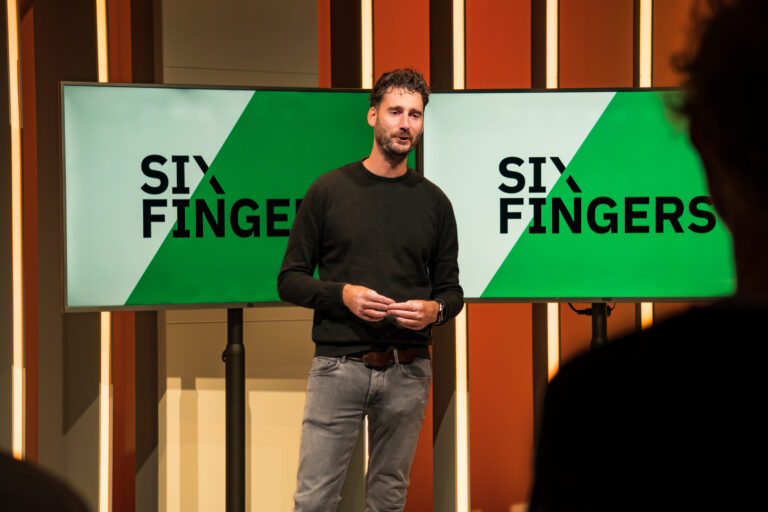
In addition to our established keynotes, we also create fully bespoke presentations. With our extensive database of signals of change — early indicators of emerging societal trends — and our own Branchmarking methodology, we draw on cases from global frontrunners and innovators across every sector.
With a diverse team of trend researchers, concept developers, industrial designers, and philosophers, we are able to shape stories from multiple perspectives, ensuring each keynote resonates with your organisation’s reality and ambitions.
Whether you want to inspire your employees, surprise your guests, or take partners along in global developments, we are happy to design a keynote that fits your needs perfectly. You are always welcome to contact us to discuss the format, focus, and direction of a bespoke presentation.